
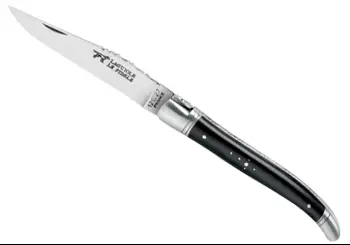
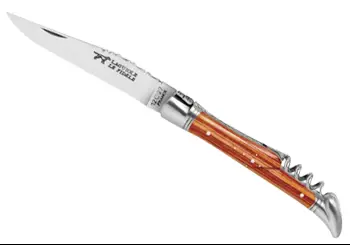
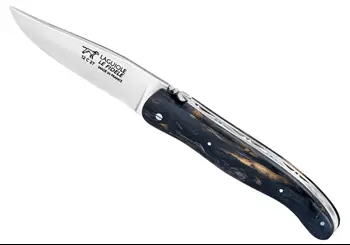
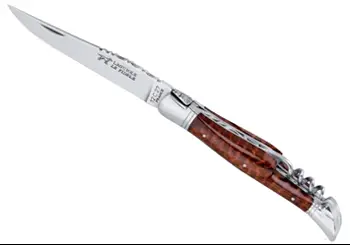
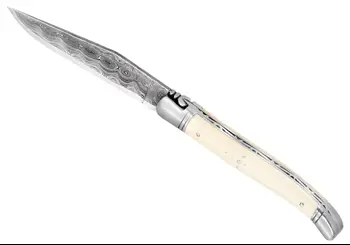
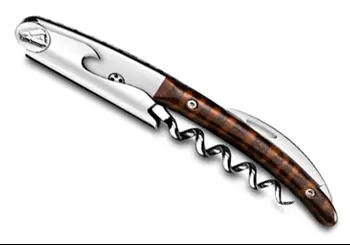
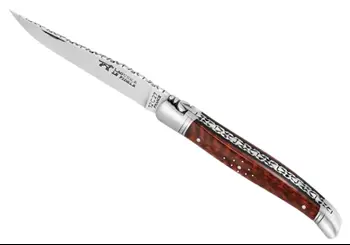
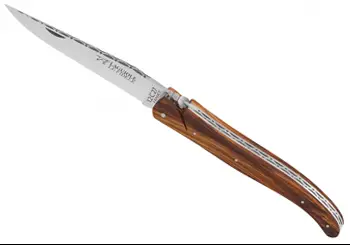
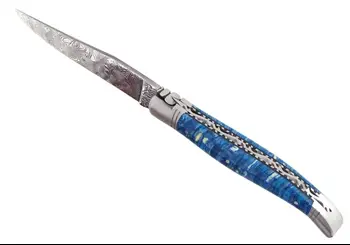
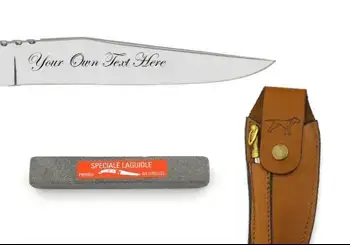
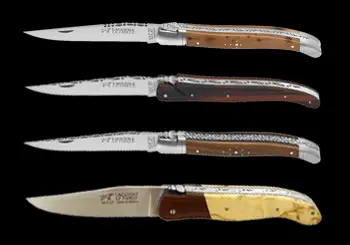
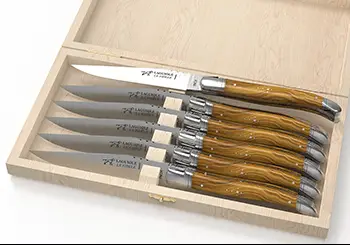
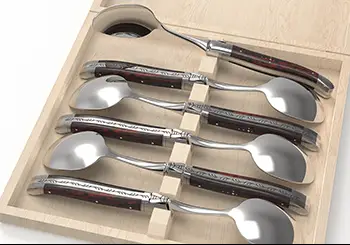
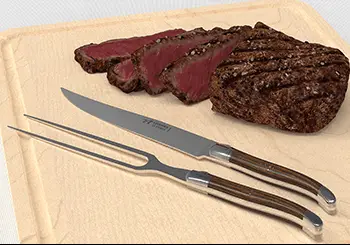
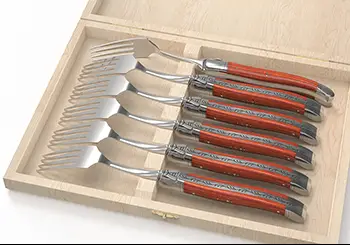





















A genuine Laguiole knife is made to last. With simple, regular Laguiole knife care, you’ll preserve the sharp edge, the beauty of the handle (wood, horn, bone, etc.), and the smooth action of the folding mechanism for many years. Below you’ll find practical guidance for cleaning, sharpening, and storage.
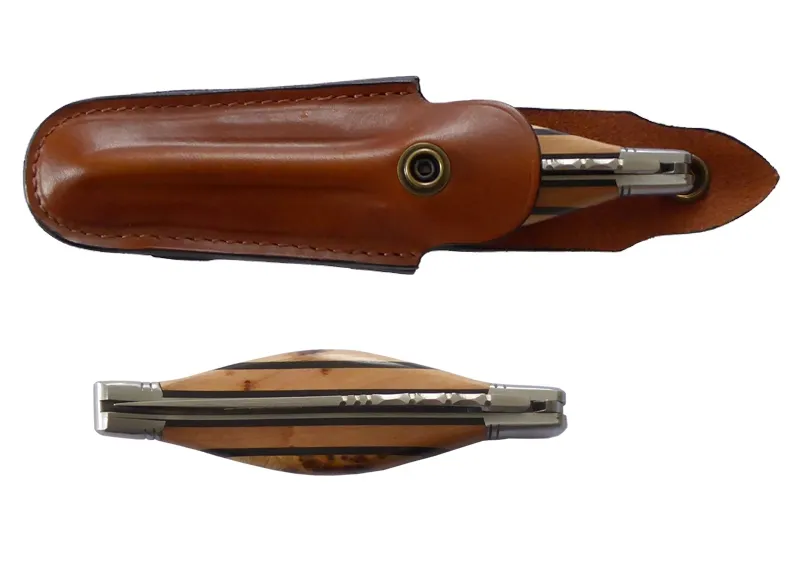
View our Laguiole leather sheaths
Contents
- Cleaning your Laguiole knife
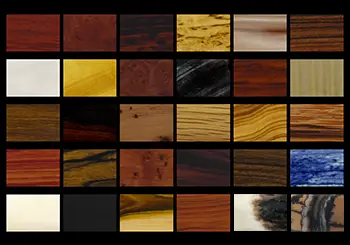
- Caring for natural handles (wood, horn, bone)
- Sharpening: stone, angle and method
- Stainless vs carbon steel: key precautions
- Storage, leather sheaths and protection
- Oiling the folding mechanism (pivot)
- Can a Laguiole knife be repaired?
- FAQ – Caring for a Laguiole knife
Cleaning Your Laguiole Knife
After use, wipe the blade with a soft cloth (or a slightly damp sponge), then dry immediately. If needed, use a small amount of mild dish soap.
What to avoid
- Dishwashers (heat + detergents + prolonged moisture).
- Soaking the knife in water.
- Keeping the knife under running water for long periods (water can enter the pivot).
- Abrasive cleaners or metal scrubbers (scratches, damaged finishes).
These habits can damage natural handle materials (horn, wood, bone…) and affect the mechanism of a folding Laguiole knife.
Caring for Natural Handles (Wood, Horn, Bone)
Wooden handles: restore and protect with oil
For wooden handles (olive wood, walnut, ebony, etc.), you can refresh the finish by applying a very thin layer of linseed oil with a soft cloth, then wipe off all excess. The goal is a light protective coat, not an oily surface.
Horn / stag horn / bone: keep it dry and avoid heat
Horn, bone and stag horn are beautiful but sensitive. Avoid prolonged humidity and strong heat sources (radiators, direct sun behind glass). In most cases, simple wiping is enough.
Explore handle materials (wood, horn, bone…)
Sharpening Your Laguiole Knife
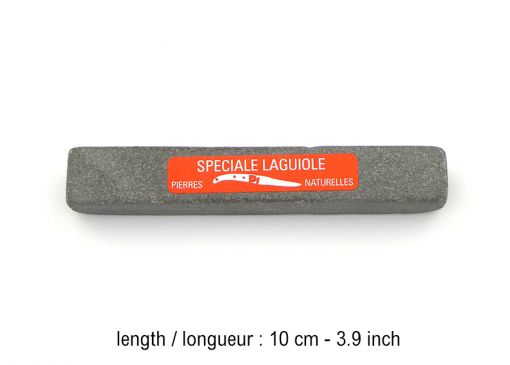
Proper Laguiole sharpening keeps the cutting edge efficient and pleasant to use. For pocket knives and small kitchen knives, the sharpening stone should stay fixed (on a stable, non-slip base).
What sharpening angle should you use?
We recommend approximately 25°. A narrower angle (e.g., 15°) can feel razor-sharp, but it may weaken the edge for everyday use.
Simple tip: hold the blade perpendicular to the stone (90°), halve the angle (45°), then halve it again—this puts you close to 22–25°.
Sharpening technique (simple method)
- Use a slightly moistened stone and keep it stable.
- Maintain a consistent angle throughout.
- Use smooth, controlled strokes—no need to press hard.
- Sharpen one side, then the other until the edge is clean and consistent.
Sharpening time depends on blade condition and steel type. Stainless steels often take longer than carbon steels, but consistency matters more than speed.
Stainless vs Carbon Steel: Key Precautions
Stainless steel blades
Stainless steel resists corrosion well, but you should still dry the blade after cleaning (especially before closing the knife).
Carbon steel blades
Carbon steel can develop a natural patina—this is normal and often appreciated. However, it is more sensitive to humidity, so careful drying is essential.
Storage and Protection
Avoid storing your Laguiole knife with keys, coins or other metal objects. This can scratch the handle and bolsters.
Leather sheaths: great daily protection, but avoid long-term storage inside
A leather sheath is ideal for everyday protection. However, if you won’t use the knife for several months, avoid leaving it inside the sheath permanently: depending on the tanning process, leather can encourage oxidation, especially on brass parts.
To restore shine to brass bolsters, use a gentle metal polish and a soft cloth.
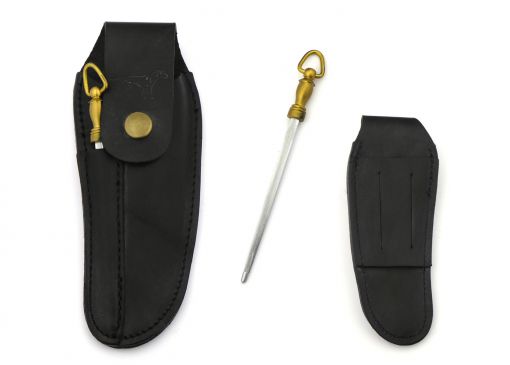
Browse all Laguiole leather sheaths
Maintaining the Mechanism of a Folding Laguiole (Pivot Oil)
If opening becomes stiff (dust, residues, minor oxidation), occasional lubrication is enough.
What oil should you use?
One drop of a light household oil (such as 3-in-1 oil) is suitable. Use very little—one drop is enough.
Procedure
- Keep the knife closed.
- Apply one drop between the blade and the spring at the pivot.
- Open and close the knife several times to distribute.
- Wipe away excess oil.
Can a Laguiole Knife Be Repaired?
Yes. A Laguiole knife is repairable, even older models. Depending on the knife and its condition, it may be possible to replace:
- a worn blade,
- a tired spring,
- a handle scale.
Depending on overall condition, repair costs may sometimes exceed replacement value—contact us for an evaluation.
Contact us for repair inquiries
Laguiole knife sets and prestige editions
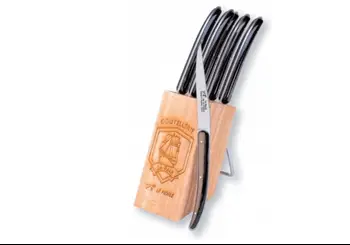
 Laguiole steak knives set with bocote wood handle
 Laguiole knife prestige edition with serpent wood handle
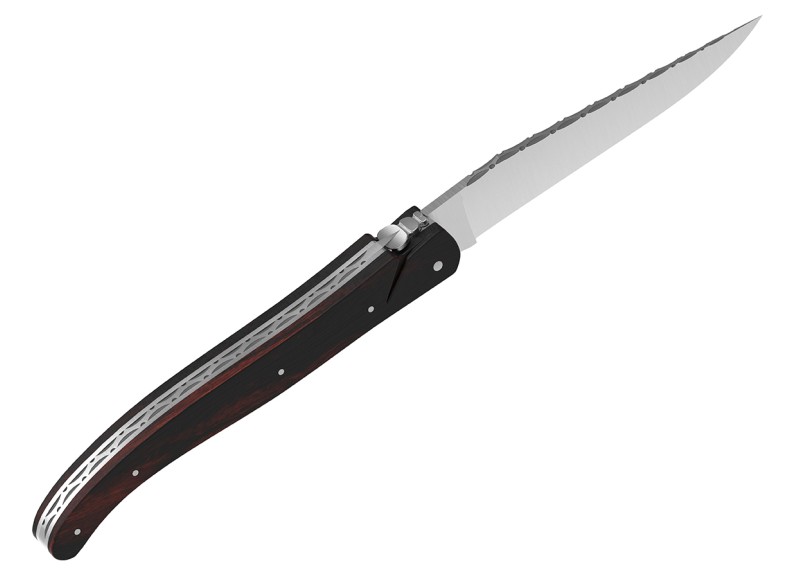 Laguiole knife full handle ironwood
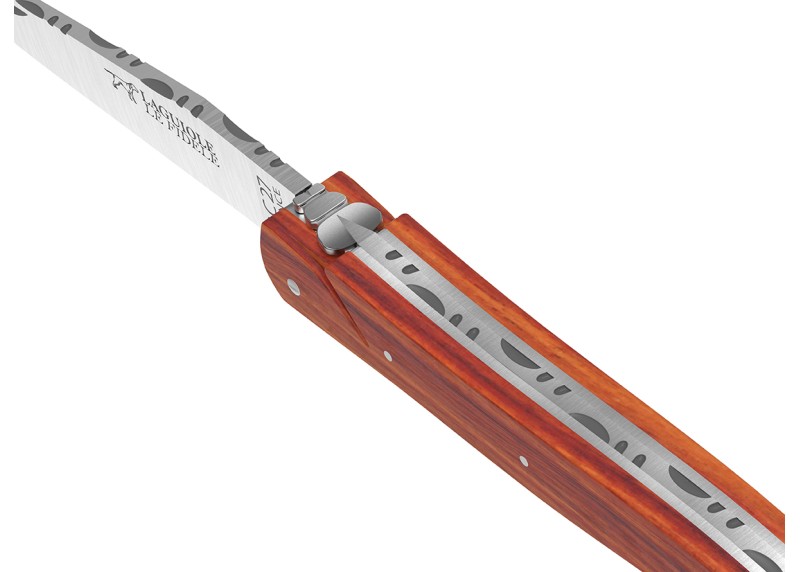 Laguiole knife full handle rosewood
 Le Thiers steak knives set with cocobolo wood handle
 Laguiole cutlery set with juniper wood handle
 Laguiole knife prestige edition with walnut wood handle
FAQ – Caring for a Laguiole Knife
Can I put my Laguiole knife in the dishwasher?
No. Dishwashers are strongly discouraged. Heat, prolonged moisture and harsh detergents can damage natural handle materials and the folding mechanism.
What oil should I use for a wooden handle?
Linseed oil is recommended. Apply a thin layer with a soft cloth and wipe away all excess.
How often should I sharpen my Laguiole knife?
It depends on usage. For frequent use, light maintenance as soon as cutting performance drops is better than infrequent heavy sharpening.
What sharpening angle is recommended?
Approximately 25° provides a good balance between sharpness and edge durability.
How do I maintain the folding mechanism?
Apply one small drop of oil at the blade pivot (between blade and spring), open and close several times, then wipe off any excess.
Can a Laguiole knife rust?
Stainless steel blades resist corrosion well but should always be dried after cleaning. Carbon steel blades may develop a natural patina over time, and require more careful drying.
Can an old Laguiole knife be repaired?
Yes. Worn blades, springs or handle scales can sometimes be replaced. Contact us for an evaluation.